
How dangerous is stroke and can it be prevented? If you have these questions in your mind then let us understand the answers to all your questions. Do you know, every year approximately 1.5 crore people suffer from stroke? Out of them 50 lakh people die, and the same number of people become crippled for life.
Stroke occurs when the flow of blood to the brain stops. As we know, blood carries oxygen and nutrition. The brain needs continuous oxygen and blood so that it can function properly. If the blood supply is cut off even for a few minutes, brain cells begin to die. This condition is called a stroke.
For example, imagine that when the lights go off, the fan stops immediately – similarly, when blood does not reach the brain, brain function stops.
Table of Contents
After a stroke, a person may have difficulty speaking, eating, thinking, or moving their hands. Some people also have trouble controlling their urine.
Causes of Stroke
A stroke occurs when blood flow to the brain is blocked or disrupted. This blockage can occur in two ways:
- By a blood clot,
- By plaque.
Plaque is a mixture of fatty substances (fat), cholesterol, waste materials, calcium, and fibrin. It gradually builds up inside arteries.
Example: Just as the flow of water slows down when dirt or debris gets stuck inside a pipe, similarly when this plaque gets stuck inside arteries, the flow of blood reduces. This causes the walls of the artery to thicken and harden, making it difficult for blood to reach the brain – and this can cause a stroke.
Types of Stroke
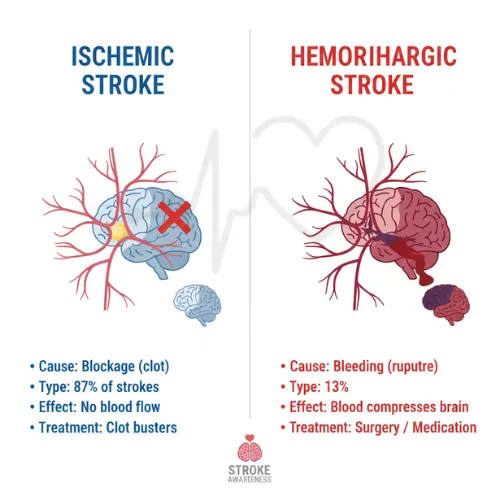
Ischemic Stroke: Most Common Type
This is the most common type of stroke. When a major artery to the brain becomes blocked, blood and oxygen supply to the brain is cut off. This causes brain cells to die.
Example: Just as a traffic jam on the road causes vehicles to stop, when an artery becomes blocked, blood flow stops—this is called an ischemic stroke.
Hemorrhagic Stroke: When a blood vessel in the brain bursts
This stroke occurs when an artery in the brain ruptures or leaks blood.
This puts pressure on brain tissues, causing damage.
Example: Just as a balloon inflates when filled with too much air, when an artery becomes weak and cannot handle the increased pressure, it ruptures—causing a hemorrhagic stroke.
Common signs or symptoms of a stroke:
- Sudden swelling or weakness of the face, arm, or leg, especially on one side of the body.
- Sudden confusion or difficulty speaking or understanding.
- Sudden difficulty seeing, whether in one eye or both.
- Sudden difficulty walking, dizziness, or loss of balance.
- Sudden severe headache without any reason.
Mini-stroke (Transient Ischemic Attack): If a person has already had a mini-stroke, they have a higher risk of having a stroke later. The symptoms of a mini-stroke appear for a short time and then disappear, but they are warning signs of a stroke.
What is a mini-stroke?
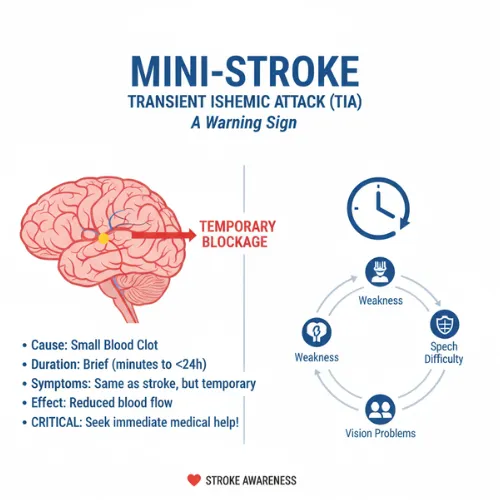
Sometimes the symptoms of a stroke resolve within 24 hours. This is called a mini-stroke or a Transient Ischemic Attack (TIA). In this case, the artery is temporarily blocked, but after some time, it reopens, and blood flow returns to normal.
Example: Just as traffic on a road may stop briefly and then clear again, in a mini-stroke, blood flow to the brain stops for a short time and then returns to normal. But be careful – this is a small warning that a major stroke could happen later, so it should never be ignored.
How Is a Stroke Diagnosed? Common Tests and Scans
In today’s advanced medical world, there are several ways to diagnose a stroke. These tests help doctors determine whether a stroke has occurred, and if so, what type it is.
CT Scan (Brain): This test shows detailed images of the brain. This helps doctors determine if there is bleeding or a blockage in the brain.
MRI (Magnetic Resonance Imaging): MRI shows the soft tissues and small details of the brain. This test can also show changes in the early stages of a stroke.
MRA (Magnetic Resonance Angiography): This test clearly shows the arteries of the brain, revealing blockages or narrowing.
Doppler sonography: This test looks at blood flow in the arteries of the neck and brain. It can indicate if blood supply is being reduced.
“Click here for complete information on these medical tests.”
Stroke Treatment Options
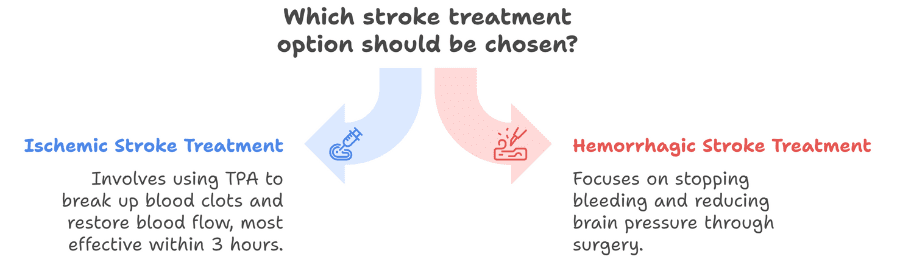
Ischemic Stroke Treatment
The main treatment for ischemic stroke is an injection called TPA (Tissue Plasminogen Activator). This works by breaking up the blood clot, restoring blood flow to the brain.
There are two common types:
- Alteplase (Activase)
- Tenecteplase (TNKase)
This injection is given through a vein in the arm (IV line)** and is most effective when given within the first 3 hours.
Example: Just as a plumber injects a chemical to clear a clogged pipe, TPA breaks up the blockage and restores blood flow.
Hemorrhagic Stroke Treatment
This type of stroke involves bleeding inside the brain, so treatment is slightly different. Doctors first locate the source of the bleeding and then perform surgery.
- Clipping: Bleeding is stopped by clipping the ruptured artery.
- Skull Drainage: The skull is drained to reduce pressure on the brain.
- Blocking: The source of bleeding is blocked so that blood does not leak.
- Burr Hole Surgery: This is a minor surgery in which the clotted blood is removed by making a small hole.
All these steps together reduce the pressure on the brain and help in preventing brain damage.
Tips to Prevent Stroke (Prevention):
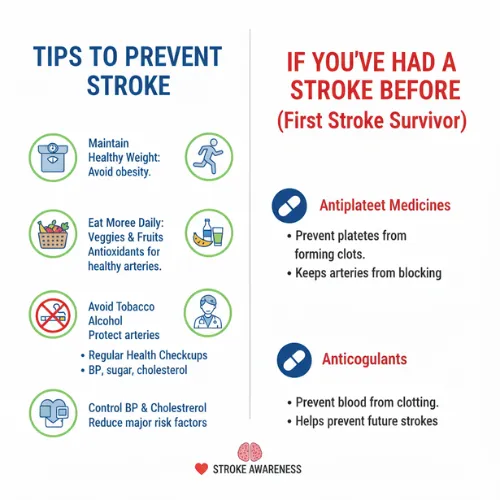
- Maintain a healthy weight: Excessive obesity can increase the risk of stroke.
- Exercise daily: A 30-minute walk, cycling, or light exercise keeps blood flow and the heart healthy.
- Eat more vegetables and fruits: These provide the body with nutrients and antioxidants, which keep arteries healthy.
- Avoid tobacco and alcohol: Smoking and alcohol can damage arteries and increase the risk of stroke.
- Regular health checkups: Check your blood pressure, sugar, and cholesterol.
- Control blood pressure and cholesterol: High blood pressure and high cholesterol are major risk factors for stroke.
If you’ve had a stroke before (First Stroke Survivor):
Antiplatelet medicines: These medicines prevent platelets from forming clots. Platelets are tiny cells that cause blood to clot. If clots don’t form, arteries won’t block, and the risk of stroke will be reduced
Anticoagulants: These medicines prevent blood from clotting. They also help prevent stroke.
In simple terms, both prevention and medicines together significantly reduce the risk of stroke and keep the brain safe.
Stroke Recovery and Life Expectancy
These numbers reflect survival and mortality after a stroke:
- Within 30 days: Approximately 10% of people die after an ischemic stroke.
- Within 1 year: Approximately 40% of people die from an ischemic stroke within the first year.
- After 5 years: Approximately 52.8% of people survive for 5 years after a stroke.
- After 10 years: Approximately 36.4% of people survive for 10 years after a stroke.
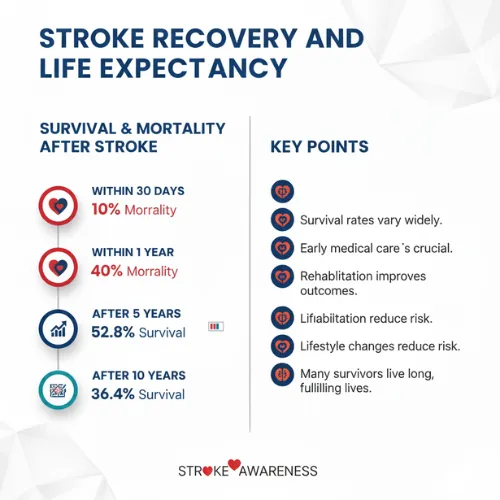
In simple terms, the initial 1 year after an ischemic stroke is the most critical, and survival rates gradually decline as we go along. Regular treatment and a healthy lifestyle help improve survival.
Latest Stroke Research (2024–2025)
- Global Impact
- There are 12 million new stroke cases worldwide every year.
- Fact: 1 in 4 people aged 25 or older will experience a stroke in their lifetime.
- If trends continue, stroke deaths could reach 9.7 million per year by 2050.
- This data shows that stroke is a very common and serious health problem, and prevention and awareness are crucial. pmc.ncbi.nlm.nih
- Faster Diagnosis
Mobile Stroke Units (MSU): These are special ambulances equipped with a CT scanner. This scans the patient’s brain immediately in the ambulance. This reduces treatment start time by 15–30 minutes and improves the patient’s chances of recovery.- Advanced Imaging and AI: CT perfusion and MRI penumbra maps give doctors detailed information about affected areas of the brain.
- AI-assisted scan interpretation allows scans to be analyzed quickly, allowing doctors to make faster decisions.
These technologies make stroke treatment faster and more effective. pmc.ncbi.nlm.nih
- Improved Acute Treatments
- Tenecteplase (TNK-tPA):
This is a single-injection clot-busting medication that breaks up blood clots.
• It has equal or better efficacy than Alteplase.
• It has a reduced bleeding risk.
• Some trials (such as the EXTEND-IA TNK and NOR-TEST) have shown that it may be effective even after 4.5 hours. - Mechanical Thrombectomy:
This is a procedure that uses stent retrievers (such as Solitaire and Trevo) to remove large artery clots.
• In select patients, this treatment can be beneficial even within 24 hours of stroke.
• Trials such as MR CLEAN, ESCAPE, REVASCAT, DAWN have confirmed its benefits.
In simple words, both TNK-tPA injection and mechanical thrombectomy help in saving life and improving recovery in severe cases of stroke.
pubmed.ncbi.nlm.nih+1
- Tenecteplase (TNK-tPA):
- Neuroprotective Strategies
Researchers propose a six-category taxonomy to guide drug development. These terms are associated with advanced supportive strategies of stroke treatment:- Bridging agents: These medications help restore blood flow and reduce brain damage in the early stages of a stroke.
- Blood-brain barrier stabilizers: These strengthen the brain’s protective barrier to prevent harmful substances from entering the brain.
- Microcirculation protectors: These maintain blood flow in small arteries and capillaries.
- Reperfusion injury blockers: Sometimes, restoring blood flow can cause additional injury; these blockers prevent this damage.
- Edema reducers: Swelling may occur in the brain after a stroke; these medications help reduce swelling.
- Delayed PubMed: This term is used in a research context, meaning referring to scientific studies or trials that provide data for late-phase stroke treatment. ncbi.nlm.nih
- Post-Stroke Care Advances
- Personalized Rehabilitation: This therapy is tailored to each patient’s needs. It includes physical therapy (movement and strength), speech therapy (speaking and understanding), and cognitive therapy (thinking and memory skills).
- Tele-rehabilitation: This therapy is provided remote, meaning the patient can receive online coaching and exercises from home.
- Patient-centered care: In this, a multidisciplinary team — doctors, therapists, nurses, and caregivers — work together to create a patient recovery plan. This approach makes recovery more effective and faster. pmc.ncbi.nlm.nih
- Equity and Access
The World Stroke Organization calls for- Low-cost stroke surveillance systems: These systems provide affordable tools to track and monitor stroke cases, and timely action can be taken.
- FAST public awareness campaigns: FAST stands for Face, Arm, Speech, Time. These campaigns educate people to recognize early signs of stroke and seek immediate treatment.
- Investment in MSUs and stroke centers: Providing funding and resources to Mobile Stroke Units and specialized stroke centers ensures fast diagnosis and treatment for patients.
- Training community health workers: By training local health workers, they help the community with stroke prevention and early detection.
- Mobile apps for education and risk monitoring: Through apps, people can track stroke risk factors and receive education and guidance, such as blood pressure, sugar, and lifestyle tips.. pmc.ncbi.nlm.nih
Early signs and symptoms of stroke in adults?
Sudden weakness in the face, arms, or legs, difficulty speaking or understanding, problems with vision, severe headache, or loss of balance.
How to prevent ischemic and hemorrhagic stroke naturally?
Healthy diet (fruits and vegetables), regular exercise, tobacco/alcohol abstinence, blood pressure and cholesterol control, and regular health checkups.
Best treatment options for stroke recovery at home?
Physical therapy, speech therapy, cognitive exercises, proper medications jaise antiplatelets ya anticoagulants, aur healthy lifestyle follow karna.
Stroke risk factors and warning signs after age 50?
High blood pressure, high cholesterol, diabetes, smoking, alcohol, obesity, and family history. Warning signs include sudden weakness, confusion, speech problems, and balance loss.
Rehabilitation exercises for stroke survivors at home?
Walking, arm/leg stretches, balance exercises, hand grip exercises, and speech practice. These exercises help in improving recovery and daily activities.

- Nipah Virus: A Complete Guide to Symptoms, Treatment, and Prevention (2025 Update) - March 18, 2026
- Nipah Virus Mortality Rate and Survival Chances: A Comprehensive 2025 Guide - February 9, 2026
- Warning Signs Your Body Uses to Show Health Issues - February 2, 2026