
Nipah Virus Mortality Rate and Survival Chances remain a major concern due to its high fatality risk and limited treatment options worldwide. When a new or dangerous disease spreads in the world, people’s attention immediately shifts toward it. One such dangerous virus is the Nipah Virus (NiV). This is not like the normal flu or COVID. Flu and COVID can spread to more people, but their death rate is comparatively low. The biggest danger of the Nipah Virus is its high death rate. Doctors and health officials focus more on this point: what are the chances of survival for people infected with this virus.
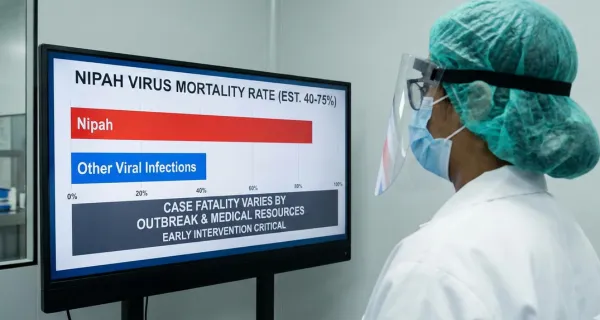
Understanding the death rate of this virus is not limited to just looking at numbers. This shows how serious the disease is, and if it is detected early, the chances of saving the patient can increase. The death rate of Nipah Virus has been seen to be approximately 40% to 75% in different outbreaks, which is quite high. But it is not possible to understand the full situation just by looking at numbers, because survival depends on many other factors as well.
In this guide, it will be explained which factors affect a patient’s chances of survival. Along with this, it will also be explained how Nipah Virus spreads, what its symptoms are, and how the new research happening in 2025 can help in controlling this virus in the future.
Table of Contents
Understanding the Nipah Virus Mortality Rate and Survival Chances
To understand the real danger of Nipah Virus, it is necessary for us to look at its past record. Since this virus was first found in 1999, there have been outbreaks in different places from then until now. In every outbreak, the death rate and people’s chances of survival have not remained the same. Sometimes the death rate was higher, sometimes a little lower. This means that the impact of Nipah Virus keeps changing according to time, place, and situation.
Why Is the Mortality Rate So High?
According to the World Health Organization (WHO), the Case Fatality Rate (CFR) of Nipah Virus is between approximately 40% to 75%. CFR means how many people out of those infected with the virus eventually die. This percentage is much higher than other viral diseases. If we compare, the death rate in normal seasonal flu is less than 0.1%. This makes it clear how dangerous Nipah Virus can be.
“Learn about Warning Signs Your Body Uses to Show Health Issues”
Several Factors Contribute to High Mortality
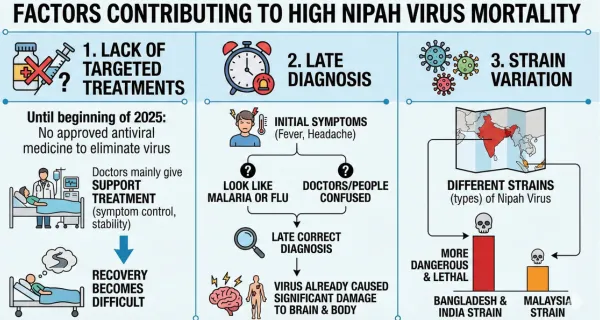
1. Lack of Targeted Treatments:
• Until the beginning of 2025, there is no approved antiviral medicine available to directly eliminate Nipah Virus.
• Doctors mainly give support treatment to the patient, such as controlling symptoms, keeping the body stable, etc.
• Because of this, recovery becomes difficult.
2. Late Diagnosis:
• Initial symptoms are normal, such as fever and headache.
• These symptoms look like malaria or flu; therefore, people and doctors sometimes get confused.
• By the time the correct diagnosis happens, the virus has already caused significant damage to the brain and body.
3. Strain Variation:
• There are different strains (types) of Nipah Virus.
• The strain found in Bangladesh and India is considered more dangerous and lethal than the strain in Malaysia.
Factors Influencing Survival Chances
Numbers may look a bit scary, but there are chances of survival in Nipah Virus. If treatment is received at the right time and there is proper care, survival is possible. The chances of surviving this virus mainly depend on some important things.
Improving Survival Chances
1. Early Intervention:
• If the patient gets treatment early, the chances of recovery increase.
• Supportive care such as keeping the body hydrated, controlling fever, and keeping the patient stable helps a lot.
2. Healthcare Infrastructure:
• Where hospital facilities are good, such as where ventilators and ICU are available, the chances of patients surviving are higher.
• In remote or rural areas, facilities are fewer; therefore, more death cases are seen there.
3. Viral Load:
• Viral load means how much virus entered the body initially.
• If a person is exposed to a large quantity of the virus, the infection can be more severe.
What is Nipah virus? Origins and Transmission
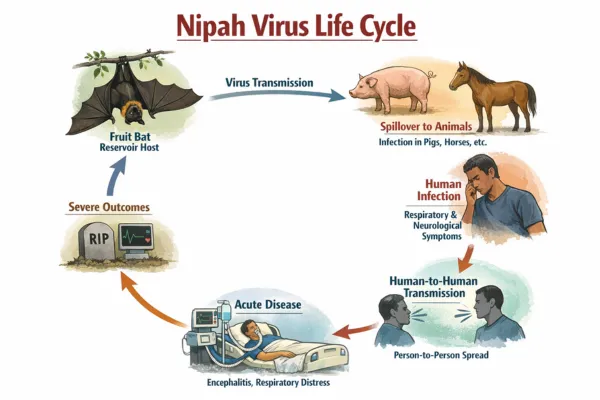
Nipah Virus is a zoonotic virus, meaning it spreads from animals to humans. This virus is part of the Henipavirus group. The natural host of this virus is a special type of fruit bats, which are also called Pteropus bats. These bats themselves usually do not appear sick, but they can carry the virus and pass it on to other animals or humans.
How It Spreads
Understanding how the virus spreads is very important because outbreaks can be controlled through this, and people’s chances of survival can increase.
1. Animal-to-Human Transmission:
• This is the most common method of infection.
• If a person drinks date palm sap that is contaminated with the urine or saliva of bats, the virus can enter the body.
• If a fruit has been bitten by bats and a human eats it, the infection can occur then as well.
2. Human-to-Human Transmission:
• In the later stage of the disease, when the patient develops breathing problems or respiratory symptoms, the virus can spread to other people.
• This virus can reach family members or healthcare workers through close contact with an infected person’s body fluids (such as saliva, mucus, etc.).
Symptoms: Recognizing the Signs Early
Recognizing symptoms early in Nipah Virus is the most important way to increase a patient’s chances of survival. If symptoms are understood on time and treatment begins, serious complications can be controlled to a great extent.
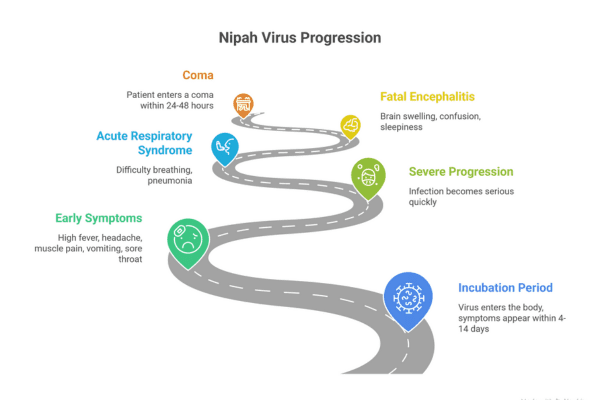
Incubation Period:
• Incubation period means the time from when the virus enters the body until symptoms appear.
• In Nipah Virus, symptoms usually appear within 4 to 14 days.
• In some rare cases, this period can be up to 45 days.
Early Symptoms (Prodromal Phase):
• High fever
• Headache
• Muscle or body pain
• Vomiting and sore throat
Severe Progression:
• If the infection is not controlled on time, the disease can become serious very quickly.
Acute Respiratory Syndrome:
• Difficulty in breathing occurs.
• Serious lung problems like pneumonia can occur.
Fatal Encephalitis:
• Swelling occurs in the brain.
• The patient may experience excessive sleepiness, confusion, and problems in thinking or understanding.
Coma:
• Within 24 to 48 hours of neurological symptoms starting, the patient can go into a coma.
Diagnosis and Current Treatment Protocols
It is a bit difficult to diagnose Nipah Virus because the initial symptoms look like normal illnesses. Seeing fever, headache, or body pain does not immediately create a doubt of Nipah. However, when an outbreak is ongoing in an area, doctors pay more attention to the patient’s history. If the patient has handled infected pigs or has drunk raw date palm sap, doctors can suspect Nipah quickly and start tests and treatment early.
Diagnostic Tools
RT-PCR:
• This test detects the genetic material (RNA) of the virus.
• This test is done using a throat swab, urine, or blood sample.
• It is mostly used during the early (acute) stage of the disease.
ELISA:
• This test detects the antibodies formed in the body against the virus.
• This test is more useful during the slightly later stages of the disease.
Supportive Care: The Cornerstone of Survival
Until now, no officially approved or licensed treatment for Nipah Virus is available. Therefore, the main focus of doctors is to provide strong supportive care to the patient so that the patient’s condition remains stable and the chances of recovery can increase.
Supportive Care Methods:
Mechanical Ventilation:
• If the patient experiences significant problems breathing, ventilator support is provided.
• This helps the lungs to function properly.
Management of Neurological Symptoms:
• If the patient experiences seizures or brain-related problems, medicines and monitoring are used to control them.
Maintenance of Fluid and Electrolyte Balance:
• Maintaining the balance of water and minerals in the body is very important.
• For this, IV fluids or other medical support are provided.
Prevention Strategies
When a proper cure for a disease is not available, then protecting oneself from it becomes most important. In the case of Nipah Virus too, prevention is the strongest protection. If people follow some basic safety steps, the risk of infection can be reduced significantly.
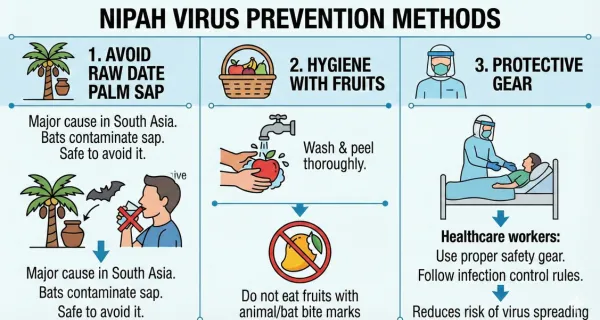
Prevention Methods:
Avoid Raw Date Palm Sap:
• In South Asia, a major reason for the spread of Nipah Virus is drinking raw date palm sap.
• Bats often contaminate this sap, so it is safe to avoid it.
Hygiene with Fruits:
• It is necessary to wash and peel every fruit thoroughly.
• If there are marks of animals or bats biting on any fruit, it should not be eaten.
Protective Gear:
• Healthcare workers should follow proper safety gear and infection control rules while treating suspected patients.
• This reduces the risk of the virus spreading to other people.
Latest Research on 2025: A Ray of Hope
Nipah Virus is considered a very dangerous virus. Its death rate is high and it can also create serious complications, which is why it is always necessary to remain careful about it. But the situation is gradually improving. Earlier data looks scary, but the medical research and advancements that have happened in 2025 have given hope for the future.
If awareness increases among people, patients receive supportive care early, and vaccines or antibody treatments are developed, then in the future, Nipah Virus will not remain as deadly as it seems now. Until then, the strongest protection is awareness, safety precautions, and proper knowledge.
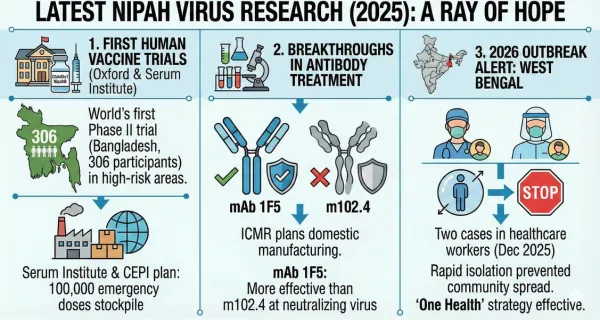
1. First Human Vaccine Trials (Oxford & Serum Institute)
At the end of 2025, significant progress was made on the Nipah Virus vaccine as the University of Oxford, in collaboration with a research organization in Bangladesh, launched the world’s first Phase II clinical trial. This trial included 306 healthy individuals, specifically from areas where the risk of a Nipah outbreak is high. The name of this vaccine is ChAdOx1 NipahB. To ensure the vaccine reaches the public quickly, India’s Serum Institute partnered with CEPI and planned to create a stock of 100,000 vaccine doses for emergency use, so they can be utilized immediately in a future outbreak.
2. Breakthroughs in Antibody Treatment
In 2025, there was also substantial progress in the treatment of infected patients. India’s ICMR began planning to manufacture monoclonal antibodies within India itself, which will reduce the need for South Asia to import expensive medicines. Researchers developed a new antibody, mAb 1F5, which is considered more effective at neutralizing the virus than the older m102.4 treatment. These developments could further improve the chances of successful treatment for patients in the future.
3. 2026 Outbreak Alert: West Bengal
At the beginning of 2026, the Nipah surveillance system was also put to the test. While Kerala had successfully controlled a small outbreak in 2025, two confirmed cases were reported in West Bengal in December 2025. These cases were found among healthcare workers, marking the first noticeable outbreak in Eastern India since 2007. According to the WHO, the patients were isolated quickly, which prevented the virus from spreading into the community. This incident demonstrates that rapid response and the “One Health” strategy can be highly effective in controlling outbreaks.
Conclusion
Nipah Virus is considered a very dangerous virus. Its death rate is high and it can also create serious complications, which is why it is always necessary to remain careful about it. But the situation is gradually improving. Earlier data looks scary, but the medical research and advancements that have happened in 2025 have given hope for the future.
If awareness increases among people, patients receive supportive care early, and vaccines or antibody treatments are developed, then in the future, Nipah Virus will not remain as deadly as it seems now. Until then, the strongest protection is awareness, safety precautions, and proper knowledge.

- Nipah Virus: A Complete Guide to Symptoms, Treatment, and Prevention (2025 Update) - March 18, 2026
- Nipah Virus Mortality Rate and Survival Chances: A Comprehensive 2025 Guide - February 9, 2026
- Warning Signs Your Body Uses to Show Health Issues - February 2, 2026