
Coronary Artery Disease (CAD) is a common heart problem. The coronary arteries that supply blood to our hearts can become clogged by blockages due to cholesterol, fat, and calcium, called plaque. Simply, CAD means that the pipeline carrying blood to the heart gradually becomes clogged. If this condition is not controlled in time, it can lead to a heart attack.
Approximately 250 million people worldwide are affected by CAD—this includes 145 million men and 110 million women.
Meaning: This problem is very common and affects millions of people.
Table of Contents
“Coronary arteries are major blood vessels that supply oxygen and nutrients to the heart muscle.”
What is Coronary Artery Disease?
Coronary Artery Disease (CAD) is a common heart problem. The heart works like an engine that powers the vehicle of our body. Blood is the fuel that keeps this engine running. Coronary Artery Disease (CAD) is like a problem in the fuel line. It can happen either because plaque (like waste material) builds up inside or because the fuel line gets damaged. When this happens, fuel doesn’t reach the engine properly. As a result, the engine struggles to work and, in severe cases, can even shut down.
This blockage occurs due to plaque, which is made up of a mixture of cholesterol, fat, and other substances that builds up on the artery wall.
When arteries become narrowed:
• The heart cannot receive proper oxygen and nutrients to work.
• It causes issues like chest pain (angina), fatigue, and shortness of breath.
• If the plaque blocks the artery completely, then it can lead to a heart attack.
Plaque—A sticky film that forms on teeth or a buildup of substances in the body
Major Causes of Coronary Artery Disease?
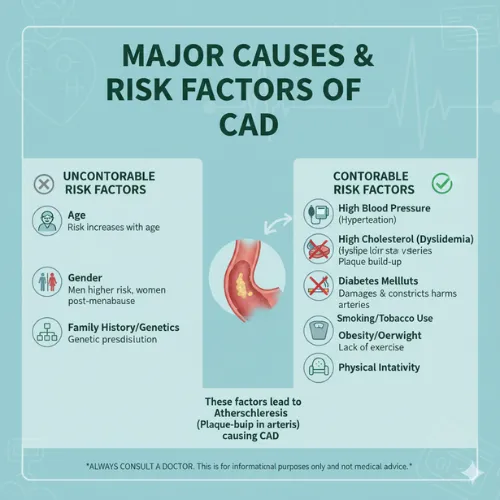
• Hypertension: Hypertension is also called high blood pressure. This means that the blood flowing through our arteries (vessels) has higher pressure than normal. If blood pressure is always high (above 120 mm Hg), the walls of the arteries get damaged. Then cholesterol and fat (plaque) easily start accumulating there.
• Hyperlipidemia: Hyperlipidemia is a condition in which there is excess cholesterol in the blood. When cholesterol builds up, it sticks to the walls of arteries (vessels) and forms plaque. Gradually, this plaque narrows and blocks the arteries.
Normal cholesterol level should be less than 200 mg/dL.
• Smoking: Smoking causes the chemicals in cigarettes to damage blood vessels. These chemicals weaken the inner lining of the vessel. When the inner lining weakens, cholesterol and fat stick more easily, and plaque begins to form. Gradually, the vessel becomes narrowed, and accelerate the plaque buildup.
• Diabetes: Diabetes causes high blood sugar levels. When sugar levels are repeatedly high, they damage the inner lining of blood vessels. After damage, the vessels become stiff and narrow. Cholesterol and fat then easily stick, causing blockages. a level of 70 to 99 mg/dL is considered normal.)
• Obesity: Obesity (excess weight) causes excess fat to accumulate in the body. This fat increases cholesterol and triglycerides, which can lead to plaque formation in the arteries. Secondly, obesity increases the risk of problems like high blood pressure, diabetes, and high cholesterol—all of which are major causes of CAD.
Having too much body fat. A BMI (body mass index) of 30 or higher is the usual benchmark for obesity in adults. It’s also a reason for CAD.
• Sedentary Lifestyle: A sedentary lifestyle means not engaging in much activity throughout the day, such as sitting for long periods of time, not exercising, or not doing physical work. This lifestyle increases body fat, causes cholesterol and blood sugar to become out of control, and can also lead to high blood pressure. All of these factors increase the risk of CAD (Coronary Artery Disease).
• Genetic Predisposition: Genetic predisposition means that if someone in your family has heart disease or CAD, your risk of heart disease may naturally be slightly higher. That is, genes (which you inherit from your parents) can affect your arteries, cholesterol levels, and blood pressure.
Symptoms of Coronary Artery Disease
Symptoms of Coronary Artery Disease:
Early stages usually have no symptoms – so people don’t realize there’s a problem at first.
Chest Pain (Angina): When the heart doesn’t get enough oxygen-rich blood, there’s chest pressure, burning, or pain.
Shortness of Breath: Not being able to breathe normally or having trouble breathing.
Fatigue: Feeling sudden or unusual fatigue, even with little exertion.
Heart Attack: When the heart doesn’t get enough blood and oxygen. It causes severe chest pain, breathing problems, nausea, and excessive sweating.
“If you have any of these symptoms, consult a doctor.“
Diagnosing Coronary Artery Disease
To diagnose CAD, doctors use tests that look at the heart’s wiring (ECG), pumping (Echo), pressure tests (TMT), and photographs of blood vessels (angiography).
Electrocardiogram (ECG) test:
• Doctors look at this graph to check whether the heart is beating properly or not.
• This is a simple and fast test used to check heart conditions.
•The doctor places small plastic patches (electrodes) on the chest, arms, and legs.
• These electrodes are connected to the ECG machine through wires.
• The machine records the heart’s electrical signals and creates a graph.
Stress Test:
• This test checks how the heart reacts to work (exercise or medication that stresses the heart).
• Exercise can include a treadmill or cycling, or the heart can be “stressed” with medication.
• Purpose of the test: To see if the heart is receiving adequate oxygen and blood supply, and if there are any blockages when the heart pumps too hard.
Echocardiogram (Echo) Test:
• This uses sound waves (ultrasound) to create images of the heart.
• Doctors can clearly see the heart’s size, shape, valves, and pumping function.
• This test helps diagnose heart diseases, such as valve problems, weak pumping, or abnormal heart structure.
Coronary Angiography:
• This is a special test that uses X-rays and a special dye (contrast material) to clearly show the heart’s blood vessels.
• The doctor injects the dye into the blood.
• As the dye flows through the arteries, the arteries become clearly visible on X-ray images.
• If there is any blockage or narrowing, it becomes immediately visible.
CT Scan (for the heart: Cardiac CT Scan / CT Coronary Angiography):
• This is a medical imaging test that uses X-rays and a computer to create detailed images of the inside of the body.
• For the heart, this test provides cross-sectional images of the heart and its blood vessels.
• This allows doctors to easily see blockages, plaque, or structural problems.
“click here” to read more about these tests.
Treatment Options for Coronary Artery Disease
Lifestyle Changes:
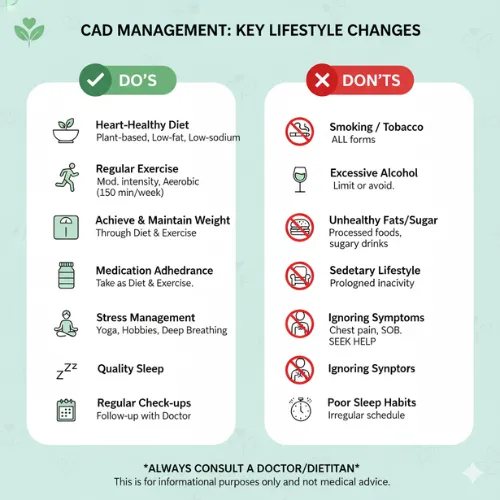
If you want to do something on your own, then just adopt a healthy lifestyle.
Healthy diet: Eating more vegetables, fruits, whole grains, and low-fat foods reduces cholesterol and plaque.
Regular exercise: Walking, cycling, or swimming strengthens the heart and keeps blood vessels healthy.
Quit smoking: Quitting smoking reduces damage to arteries and reduces the risk of blockage.
Control weight: Maintaining a healthy weight keeps blood pressure and cholesterol under control.
Stress management: Reducing stress lowers the risk of high blood pressure and heart problems.
Proper sleep: Good sleep keeps the heart and blood vessels healthy.
Click here to know all about How to Reverse CAD with Diet and Exercise.
How Medications Help with CAD
Statins:
These medicines lower “bad” cholesterol (LDL) and help prevent plaque from building up in the arteries.
Examples: atorvastatin, rosuvastatin, simvastatin.
Blood Thinners:
They prevent blood clots, which are a major cause of heart attacks.
Examples: aspirin, warfarin.
Beta-Blockers:
These reduce blood pressure and slow the heart rate, making it easier for the heart to work.
Examples: propranolol, atenolol.
ACE Inhibitors:
They relax blood vessels and lower blood pressure, reducing strain on the heart.
Examples: lisinopril, ramipril, captopril.
Medical Procedures:
Angioplasty and Stenting:
In this procedure, a small balloon is inserted into the artery to widen (open) it. A stent (a small metal mesh tube) is then placed to keep the artery open and allow blood to flow easily.
Coronary Artery Bypass Grafting (CABG):
This is a surgery in which doctors create a new path (bypass) around the blocked artery by taking a blood vessel from another part of the body (such as the leg or chest). This allows blood to flow more easily and resolves the blockage.
What are the common symptoms of coronary artery disease?
Symptoms of Coronary Artery Disease:
Early stages usually have no symptoms – so people don’t realize there’s a problem at first.
Chest Pain (Angina): When the heart doesn’t get enough oxygen-rich blood, there’s chest pressure, burning, or pain.
Shortness of Breath: Not being able to breathe normally or having trouble breathing.
Fatigue: Feeling sudden or unusual fatigue, even with little exertion.
Heart Attack: When the heart doesn’t get enough blood and oxygen. It causes severe chest pain, breathing problems, nausea, and excessive sweating
Can young people get coronary artery disease?
Yes, a younger person can develop it. But it is more common in older adults.
How is coronary artery disease diagnosed?
To diagnose CAD, doctors use tests that look at the heart’s wiring (ECG), pumping (Echo), pressure tests (TMT), and photographs of blood vessels (angiography).
Reversing coronary artery disease is possible.
Nope, CAD is not completely reversible.
How long does a person with coronary artery disease typically live?
Most people with CAD can lead long, fulfilling lives if they receive the right diagnosis and care.
Latest Research on Coronary artery disease
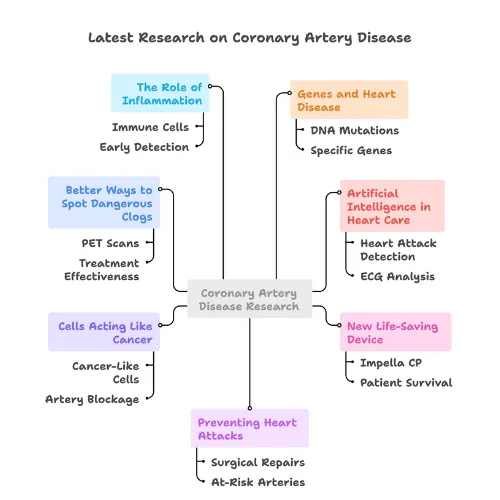
- Genes and Heart Disease
Scientists have found that small and rare changes (mutations) in DNA may account for about half of heart disease cases. They have also identified specific genes linked to heart disease.
This discovery will help make future medicines and treatments more precise and personalized.-nature+1 - Artificial Intelligence (AI) in Heart Care
·New computer tools that use AI (Artificial Intelligence) can quickly and accurately tell doctors whether a patient is having a heart attack. This reduces unnecessary hospital stays.
AI can now analyze ECG tests to predict who may develop heart problems in the future.
This allows doctors to take quick action and patients to receive early treatment.-bhf+1 - New Life-Saving Device
In a large study, doctors tested the heart pump Impella CP on patients who were in shock after a heart attack. Results showed that using the Impella CP saved more patients’ lives than using older treatments.-acc+1 - Preventing Heart Attacks Before They Happen
Researchers have found that small surgical repairs to “at-risk” arteries of the heart may prevent future heart attacks, Even if those parts don’t appear to be significantly damaged in the first place.-acc - Cells Acting Like Cancer
Scientists have found that some cells in clogged arteries behave like cancer, further exacerbating the blockage.
This discovery may help develop future medicines that can prevent these harmful cell changes.-nih - Better Ways to Spot Dangerous Clogs
Newer scans, such as PET scans, detect dangerous blockages more accurately than older scans. This allows doctors to more easily identify which parts of the arteries need to be treated most, making treatment more effective.-pmc.ncbi.nlm.nih - The Role of Inflammation
· Researchers have found that certain immune cells (the body’s defenders) play a more important role in arterial disease than previously thought.
New blood tests can detect these changes early, allowing doctors to start treatment sooner.-nature+1

- Nipah Virus: A Complete Guide to Symptoms, Treatment, and Prevention (2025 Update) - March 18, 2026
- Nipah Virus Mortality Rate and Survival Chances: A Comprehensive 2025 Guide - February 9, 2026
- Warning Signs Your Body Uses to Show Health Issues - February 2, 2026
1 thought on “Coronary artery disease (CAD): Over 250 million people are living with CAD”